Your observations

Fieldbook

An atlas of Leonardo da Vinci  ·  1452 – 1519

Saper Vedere

Knowing how to see.

He did not divide art from anatomy, water from hair, or flight from mechanics. He followed causes across disciplines. Begin with one line of moving water and watch it become weather, muscle, smoke and machine.

Which way is the water moving?

Enter the atlas

The Atlas of Causes

Four currents,
one restless mind.

Leonardo's subjects are not separate rooms. Each is a door into the next. Choose a current, or descend into the complete Codex.

Capitolo I

Il Metodo

The method — and the rules of this page

Leonardo never wrote the treatise he kept promising. What survives is a method, scattered across the notebooks and recoverable from them. Below, each of his principles is stated, and then stated again as the rule it imposed on the document you are reading. This chapter is the specification for its own presentation.

  1. i

    Saper vedere

    Knowing how to see

    Leonardo’s own phrase for the discipline he thought underlay every art and every science: not looking, but knowing how to look.

    Therefore, on this page

    Nothing on this page explains itself before you have looked at it. Captions arrive after the image, and the annotations on the paintings stay closed until you open them. The reward for patience is the only reward offered.

  2. ii

    Sfumato

    Smoke

    He instructed painters to let light and shade run together “senza linee o segni, a guisa di fumo” — without lines or borders, in the manner of smoke.

    Therefore, on this page

    There are almost no borders in this document. Chapters dissolve into the chapters beneath them; panels are separated by gradients and shadow rather than by rules; the one hairline used anywhere fades out before it reaches its own ends.

  3. iii

    Proporzione

    Proportion

    He drew the illustrations for Luca Pacioli’s De divina proportione in Milan, and spent years measuring the human body against itself.

    Therefore, on this page

    Every measurement here descends from φ = 1.618. The two columns of the page stand in golden section; the type scale climbs in powers of φ; the spacing steps are Fibonacci numbers — 5, 8, 13, 21, 34, 55, 89. No value in the stylesheet was chosen because it looked about right.

  4. iv

    Chiaroscuro

    Light and shade

    He held that an object is known by the way light dies across it, and that the painter who outlines a form has already failed to observe it.

    Therefore, on this page

    Depth is modelled with warm shadow, never with an outline or a hard drop shadow. Raised surfaces catch a thin highlight along their upper edge, the way gesso does. Nothing is pure black and nothing is pure white, because he insisted that neither occurs in nature.

  5. v

    Notomia

    Anatomy

    He dissected perhaps thirty bodies to learn what governed the surface, and drew the same shoulder from four sides so the structure beneath could not hide.

    Therefore, on this page

    Every image here can be stripped to its construction. The paintings carry an overlay that exposes their geometry; the machines can be reduced to the blueprint they were drawn from. The finished surface is never the only thing on offer.

  6. vi

    Moto

    Motion

    “Il moto è causa d’ogni vita” — motion is the cause of all life. He studied it in water, in birds, in the tendons of the hand.

    Therefore, on this page

    Nothing appears or disappears instantly. Every transition carries momentum into and out of itself on a single easing curve, and the machines keep turning whether or not you are watching them.

  7. vii

    Esperienza

    Experience

    His answer to the scholars who out-argued him: experience never deceives; only our judgements deceive us, by expecting of experience what it never promised.

    Therefore, on this page

    Claims made here are demonstrated rather than asserted. The aerial screw turns so you can see why it cannot lift itself. The refectory is walkable so you can find the vanishing point yourself instead of being told where it is.

  8. viii

    Il foglio

    The sheet

    He left roughly seven thousand notebook pages and almost no finished treatises. Geometry, shopping lists, riddles and anatomy share a single sheet.

    Therefore, on this page

    This is a notebook, not a monograph. It is set as folios with marginalia in the gutter, it writes backwards where he wrote backwards, and it admits in the colophon what it has left unfinished.

Capitolo II

Le Opere

Fewer than twenty paintings, and half of them unfinished

He completed almost nothing. The accepted corpus runs to about fifteen panels depending on who is counting, several abandoned mid-work, and it was still enough to reorganise European painting. Take the lens to any plate. Open the annotations only after you have looked.

Unrolling the plate…

Hold the lens over the surface to magnify it
    Capitolo III

    I Fogli

    The sheets

    Roughly seven thousand pages survive, perhaps a quarter of what he made. They are not organised. Anatomy shares a sheet with a shopping list; a siege engine shares one with a riddle. Below they are sorted into the five preoccupations he kept returning to, which is a convenience he never granted himself.

    Volare

    On flight

    He watched birds for thirty years and filled a codex with them. The problem he never solved is that a man has perhaps a tenth of the power-to-weight ratio the job requires.

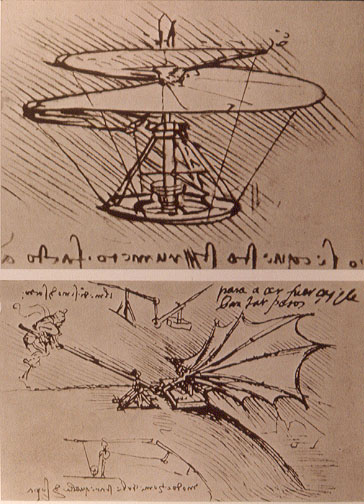
    The aerial screw

    The aerial screw

    Paris Manuscript B, f. 83v · c. 1487–1490

    A helical surface of starched linen meant to compress the air and climb it, like a screw entering wood. It cannot work: with the crew turning the shaft from inside, the whole machine would simply rotate the other way.

    Creator not recorded in the image manifest · Public domain

    A flying machine

    A flying machine

    Paris Manuscript B · c. 1488

    A wing frame of ash, cane, and fustian, worked by the pilot’s arms and legs through a lattice of cords. The linkage is exact. The power source is a man, and that is the flaw.

    Leonardo da Vinci · Public domain

    The Arno valley

    The Arno valley

    Gabinetto dei Disegni, Uffizi · dated 5 August 1473

    His earliest dated drawing, made at twenty-one, and already looking down on the world from an altitude no one had drawn from before. The hatching is left-handed, running down from upper right.

    Leonardo da Vinci · Public domain

    Guerra

    On war

    His letter to Ludovico Sforza offers nine kinds of weapon before mentioning, almost as a postscript, that he can also paint. He needed the job.

    A covered chariot

    A covered chariot

    British Museum, 1860,0616.99 · c. 1487–1488

    A conical armoured shell on four wheels, bristling with light cannon, cranked from within by eight men. As drawn, the gearing turns the front and rear wheels in opposite directions — possibly a deliberate error, possibly a draughtsman’s slip.

    Leonardo da Vinci · Public domain

    The giant crossbow

    The giant crossbow

    Codex Atlanticus, f. 149r · c. 1486–1488

    Twenty-four braccia across, of laminated wood for flex, drawn by a worm gear and released by a mallet blow to a pin. Never built. The drawing is a presentation piece, complete with a tiny figure supplied to prove the scale.

    Shubol3D · CC BY-SA 4.0

    The self-propelled cart

    The self-propelled cart

    Codex Atlanticus, f. 812r · c. 1478–1480

    Powered by two coiled leaf springs, steerable, with a programmable escapement. Built at last in 2004 by the Institute and Museum of the History of Science in Florence: it ran. Probably a theatrical device rather than a vehicle.

    Leonardo da Vinci · Public domain

    Il corpo

    On the body

    He dissected by candlelight, in cold weather so the bodies would keep, and produced anatomical drawings that were not equalled for two hundred and fifty years — and that nobody saw, because he never published them.

    Vitruvian Man

    Vitruvian Man

    Gallerie dell’Accademia, Venice · c. 1490

    Vitruvius claimed the body fits both a circle and a square. It does not, quite. Leonardo’s solution is to give the two figures different centres — the navel for the circle, the groin for the square — and let the limbs move between them.

    Leonardo da Vinci · Public domain

    Studies of the foetus in the womb

    Studies of the foetus in the womb

    Royal Collection, Windsor · c. 1511

    The first accurate drawing of a human foetus in the uterus. The womb is opened like a seed case. The cotyledons on the inner surface belong to a cow — he had dissected one, and borrowed the detail.

    Leonardo da Vinci · Public domain

    Head of a man in profile, with proportions

    Head of a man in profile, with proportions

    Royal Collection, Windsor · c. 1490

    The head divided and subdivided into a grid of relations, each interval measured against the others. A face treated exactly as he treated a machine: something whose parts must be shown to agree.

    Leonardo da Vinci · Public domain

    Natura

    On nature

    Water, weather, plants, cats. He drew whatever moved, and he drew it as a system of forces rather than as a shape.

    Water passing obstacles

    Water passing obstacles

    Royal Collection, Windsor · c. 1508–1509

    He called water il vetturale della natura, the carrier of nature. These are vortices drawn from observation, three and a half centuries before anyone had the mathematics for turbulence.

    Creator not recorded in the image manifest · Public domain

    A deluge

    A deluge

    Royal Collection, Windsor · c. 1517–1518

    From the last years, a series in black chalk in which the world ends. The same spiral he found in water and in hair is here at the scale of weather, tearing down mountains.

    Leonardo da Vinci · Public domain

    A star-of-Bethlehem and other plants

    A star-of-Bethlehem and other plants

    Royal Collection, Windsor · c. 1506–1512

    Botanically exact and compositionally impossible — the leaves spiral outward with a force no plant has. He is drawing the growth, not the specimen.

    Leonardo da Vinci · CC BY-SA 4.0

    Cats, lions and a dragon

    Cats, lions and a dragon

    Royal Collection, Windsor · c. 1517–1518

    A sheet of cats in every attitude a cat adopts, with a dragon inserted among them on the same terms, drawn from the same anatomy. He is testing whether an invented animal can be made to obey observed rules.

    Leonardo da Vinci · Public domain

    Il mestiere

    On the craft

    Studies made in service of paintings, and studies made in service of nothing in particular.

    Study of drapery

    Study of drapery

    Fondation Custodia, Paris · c. 1475–1482

    Verrocchio’s workshop exercise: soak linen in clay slip, arrange it, let it set, then draw it in brush and wash on prepared linen. Pure tone, no contour — the sfumato method, learned as an apprentice drill.

    Leonardo da Vinci · Public domain

    Study of a central-plan church

    Study of a central-plan church

    Paris Manuscript B · c. 1488

    Plan and elevation on one sheet, a domed core budding smaller domes. He built nothing, but Bramante was in Milan at the same time, and these sheets are part of the argument that ends at Saint Peter’s.

    Leonardo da Vinci · Public domain

    The Sforza monument

    The Sforza monument

    Manuscript page on the casting · c. 1490s

    A bronze horse three times life size. He got as far as a full-scale clay model, then the bronze was requisitioned for cannon and the French used the model for crossbow practice.

    Leonardo da Vinci · Public domain

    A grotesque head

    A grotesque head

    Drawing, pen and ink · c. 1490s

    He collected faces at the edge of what a face can do. Vasari says he would follow an interesting-looking stranger across Florence for a whole day to memorise him.

    Leonardo da Vinci · Public domain

    Capitolo IV

    Le Macchine Vive

    The machines, set in motion

    Three animated readings of the drawings, built as line models you can turn over in your hands. They are explanatory diagrams rather than measured reconstructions: observed parts, inferred linkages, and open questions remain visible together.

    Capitolo V

    Dentro i Dipinti

    Inside the paintings

    A painting in one-point perspective is a set of instructions for rebuilding a room. Here two of them are carried out. The refectory of the Last Supper is reconstructed from its own orthogonals and made walkable; the Mona Lisa demonstrates how sfumato exploits the difference between foveal and peripheral vision. Both scenes stay asleep until you enter them.

    Interpretive perspective model

    The refectory

    Santa Maria delle Grazie, Milan, 1495–98. The painted architecture is not decoration: it is a continuation of the real room, calculated so that the wall appears to open. Every orthogonal converges on Christ's right temple.

    Walk forward and the coffers close over you. Find the point where the room stops distorting — that is where Leonardo stood to set it out.

    Perceptual demonstration

    The shifting smile

    Move your gaze across her face. The smile appears to grow when you look at the eyes, and flatten when you look directly at the mouth. You are not imagining it.

    Leonardo painted the corners of the mouth in sfumato — soft, low-frequency brushwork with no hard edge. Peripheral vision, which is tuned for exactly that kind of signal, reads more of an upturn into the blur than foveal (direct) vision does. The expression changes because your visual system changes, not the picture.

    Research: Margaret Livingstone demonstrated this in 2000 by filtering the painting into spatial-frequency bands. The smile lives almost entirely in the low frequencies — invisible to direct scrutiny, vivid in the corner of your eye. This scene simulates that acuity falloff so you can feel it happen.
    Capitolo VI

    Lo Specchio

    The mirror

    He wrote right to left, letters reversed, so that his notebooks read correctly only in a mirror. The romantic explanation is secrecy. The likelier one is that he was left-handed, and writing backwards keeps the hand out of the wet ink. Write something below and watch it go over.